An unchanged SUI balance does not prove staking rewards are missing. Compare native stake principal, pool rewards and spendable SUI before changing a position.
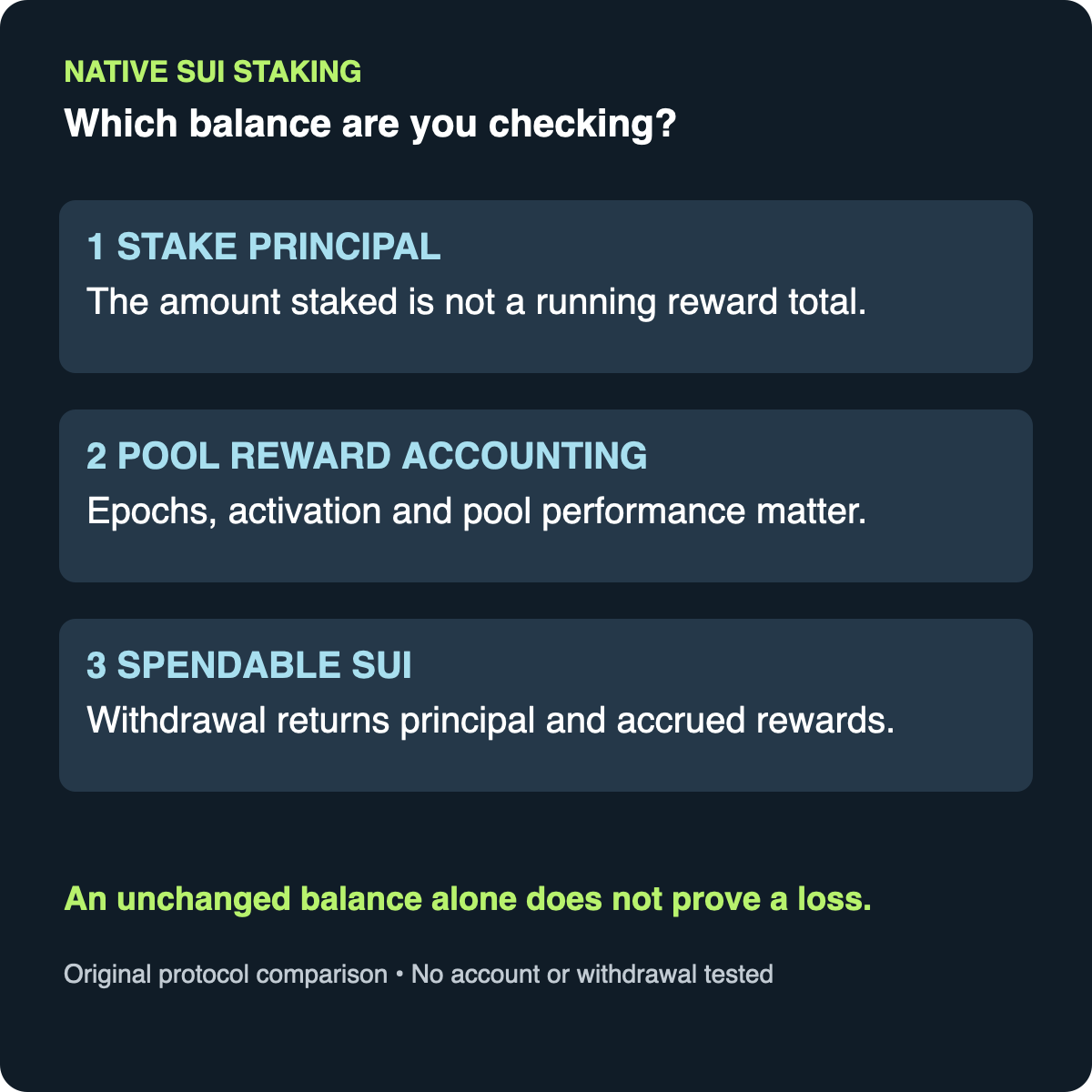
Native SUI staking rewards do not have to appear as new, spendable SUI in your wallet each day. Separate the amount originally staked, rewards accounted for by the validator pool, and the SUI returned when that stake is withdrawn. An unchanged balance alone does not show which of those you checked.
A historical staking discussion captures the confusion: a participant reported months of staking with no visible rewards and asked whether they were received only on unstaking. The report supplies the question; HideFi has not examined that position or verified its eventual payout.
Is the unchanged number your principal?
Start with the existing native staking record, rather than the wallet’s general spendable balance. Sui’s staking-pool reference describes a stake object containing its pool, activation epoch and principal. Its principal accessor returns the staked amount; reward accounting is separate.
That gives you a useful comparison: a principal field staying unchanged is different from a reward estimate staying at zero. If your wallet or explorer shows a separate reward estimate, compare the same stake record and network. If you cannot identify what a number measures, ask that tool’s official support before interpreting it as lost rewards. This guide does not prescribe a wallet-specific button path.
Accruing rewards is different from receiving them
The official tokenomics guide explains that validator pools compound rewards through exchange-rate accounting at epoch boundaries. Its unstaking section describes returning principal and accumulated rewards together as SUI. This explains why no daily addition to your liquid balance is not, by itself, evidence of missing earnings.
This scope is ordinary native staking. A liquid-staking token or an exchange’s staking product needs its own provider’s accounting and withdrawal rules; a token name alone does not establish equivalent treatment.
Check the activation epoch before counting rewards
The framework reference says a new stake starts counting in the next epoch. Rewards require a full active epoch. Sui’s epoch documentation puts Mainnet epochs at about 24 hours. Count completed epochs, rather than assuming that one calendar day since submission must produce a payment.
That timing explanation does not account for months of a genuinely zero estimate. The tokenomics guide also identifies validator commission and performance as reward factors. The framework documents that an inactive pool stops earning. Preserve the record and ask official wallet or validator support to distinguish accounting, pool status and a display problem; no particular return is guaranteed.
Do not unstake just to test a balance
Reading a record is separate from submitting a withdrawal. If you later choose to unstake, use your wallet’s current official instructions and account for transaction gas; the separate all-SUI-staked gas checks address that constraint. HideFi has not connected a wallet, calculated this user’s rewards or tested a withdrawal.
Official sources
Product interfaces and recovery policies can change. Confirm the current steps before acting.