A new Sui address does not need activation. Check the full address and network, then ask the exchange how it verifies an unused destination.
A Sui forum user reported that their exchange had not credited a confirmed USDC transfer. Support asked them for a new Sui address with no transaction history, but then said it could not verify the unused address. That leaves a practical question: do you have to send something first to make a Sui address real? No. Sui does not require an on-chain activation transaction for a new address to receive assets. The exchange’s verification rule still applies to its own recovery process. Sui’s exchange integration guide documents the protocol behavior.
Check the address your wallet actually gave you
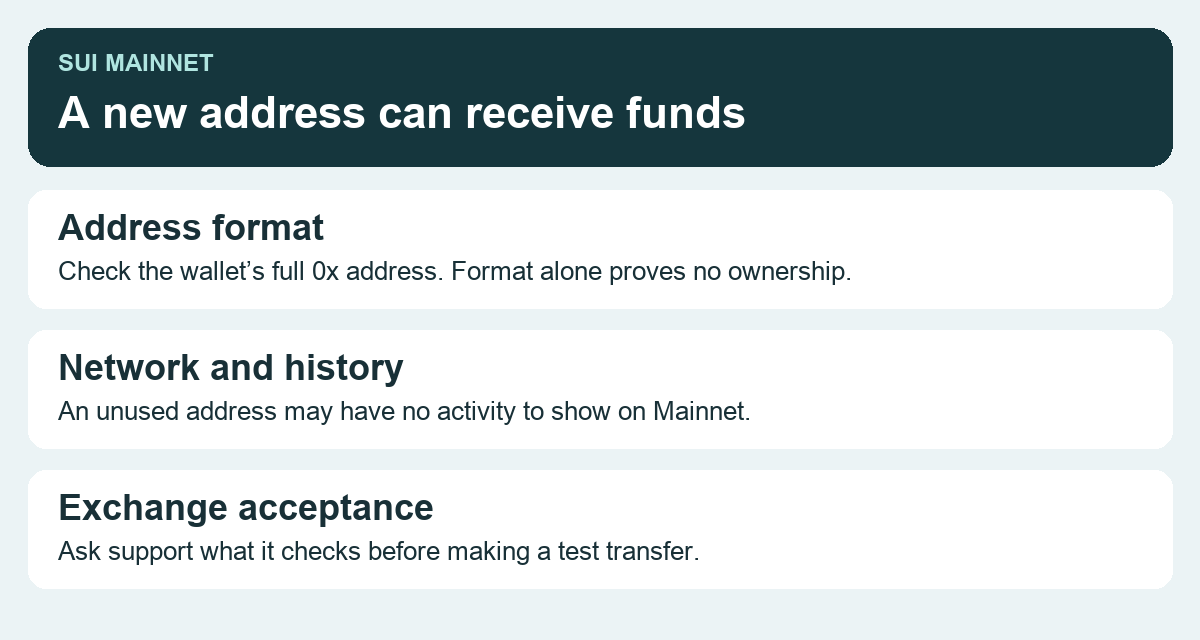
Copy the full public address from the self-custody wallet you intend to receive with and compare it character for character with what the exchange shows. The conventional display is 0x followed by 64 hexadecimal digits, as shown in Sui’s address troubleshooting guide. Check that the exchange has selected Sui Mainnet, the production network described in the network guide. A string that matches the format can still be the wrong address or a value copied from a different field. The check does not prove that you control it or that the exchange has accepted it.
If an explorer returns no history for a newly created address, confirm you are searching on Mainnet and pasted the full address. There may be nothing to display for an unused address. An empty result alone does not establish that the address is invalid. Nor does the address format establish that a deposit method supports the asset you want to receive.
Ask what the exchange requires before sending a test transfer
If support specifically asked for an address with no prior activity, keep it unused while they confirm their requirement. A test transfer can add activity and may make the address ineligible under their rule. The protocol needs no activation, so a test transfer is not necessary for that purpose.
Reply inside the official support case and ask whether their check is for address format, Mainnet activity, or a separate eligibility rule. Share the relevant Sui documentation so they can distinguish a newly derived address from an address with recorded activity. Ask them to confirm which public address and asset they can use for recovery. Keep recovery words and private keys out of the case.
This guide cannot decide whether an exchange can recover an unsupported deposit. If the original transfer is confirmed and the service did not credit it, the receiving service needs to check its supported token and network requirements. For that earlier stage, see how to distinguish a confirmed transfer from a missing exchange credit.
Official sources
Product interfaces and recovery policies can change. Confirm the current steps before acting.