A Base withdrawal can succeed on Base while still needing proof or finalization on Ethereum. Find the next action and check whether an old proof is invalid.
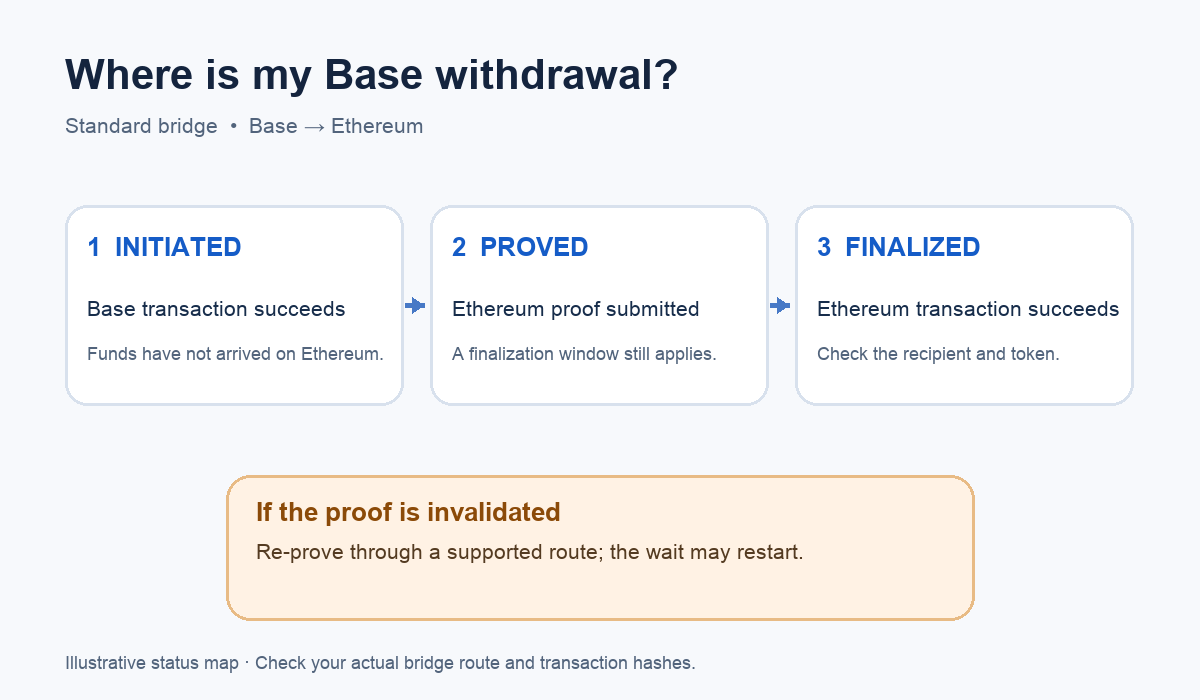
A Base withdrawal to Ethereum can say ‘successful’ on Base while no ETH has reached Ethereum yet. For a standard withdrawal, that Base transaction starts the process; it does not complete it. Check the withdrawal's route and current stage before trying anything else. A canonical withdrawal needs an Ethereum proof and an Ethereum finalization transaction. If the proof was invalidated, it may need to be submitted again. Base's current withdrawal specification describes all three stages and when re-proving is possible.
First, was this a standard withdrawal or a fast bridge?
Open the transaction in the bridge you actually used and save its Base transaction hash. Check the route or provider in its activity record. This matters because a fast bridge may use a provider's liquidity and support process; it does not follow the standard bridge's prove-and-finalize schedule. Base's bridge comparison makes this distinction. If you used a swap, exchange deposit, or fast bridge, follow that provider's transaction status and support route instead of trying to re-prove a canonical withdrawal.
If the route was the standard bridge, check the Base transaction on a Base block explorer. A successful Base transaction confirms that the first stage was submitted; it does not prove that the Ethereum-side stages happened. The same wallet's Ethereum balance can remain unchanged until finalization.
What does ‘waiting to prove’ mean?
The bridge must first have a Base state on Ethereum that includes your withdrawal. Base says this usually takes about 20 to 60 minutes before the proof can be submitted, though this is an estimate rather than a deadline. Return to the same bridge's withdrawal activity and look for a prove action or an Ethereum proof transaction. Do not mistake a Base initiation hash for an Ethereum proof hash. If the prove action is available, review the destination, amount, network, and Ethereum gas cost in your own wallet before confirming it.
If no action appears after the relevant state should have been posted, check Base's network status and the bridge provider's own status. Keep the Base hash and any error text. Base says the former bridge at bridge.base.org has been deprecated; use the routes listed in Base's current documentation to identify a current interface, or contact the provider you used. Do not assume an unrelated bridge can find your old withdrawal.
Already proved, but still waiting to finalize?
Find the Ethereum proof transaction in the bridge history or Ethereum explorer. Then check whether the finalization window has passed and whether a finalize action is available. As of our October 31, 2026 review, Base's Beryl update says the common single-proof path has a 5-day window; a dual-proof path can be 1 day. Older Base withdrawals and different routes may have different timing. The window and proof maturity both matter, so a calendar estimate alone does not establish that finalization is ready. If the bridge offers a finalization transaction, verify the Ethereum network and transaction details before confirming. The withdrawal is complete only after the Ethereum finalization succeeds and the destination receives the asset.
Could an old proof need to be submitted again?
Yes, but a delay does not by itself prove that your proof is invalid. Base's protocol documentation says a withdrawal can be re-proven against a different game if the first one is invalidated; re-proving resets that submitter's proof timestamp. An official Optimism upgrade notice documents a concrete historical case: its 2024 OP Mainnet fault-proof upgrade invalidated pending proofs and required users to re-prove, restarting the wait. That OP incident is evidence that this failure mode exists, not evidence that every Base withdrawal is affected.
If the bridge specifically says the earlier proof is invalid, its dispute game was rejected, or it presents a re-prove action, verify the withdrawal hash and follow that bridge's current supported path. Expect the applicable maturity delay to restart. If it shows a valid proof still waiting, do not pay to re-prove merely because the transfer is slow. If the interface gives no reliable status, give the Base initiation hash, any Ethereum proof hash, asset, amount, and bridge name to the bridge's official support channel. Public hashes are enough to investigate; never send a seed phrase, private key, or remote-access session.
What if it says finalized but the balance is still missing?
Check the Ethereum finalization transaction and its recipient address and token, not only the bridge's success label. If finalization succeeded but a wallet app shows no balance, verify the recipient and asset on Ethereum before changing wallet settings. If the finalization transaction failed or the target is a contract, the ordinary re-prove path may not fix it; Base's technical specification notes that a verified message can fail when relayed to its target. Take the exact transaction hashes to the bridge provider or relevant contract's official support. There is no universal recovery button.
The useful split is simple: waiting to prove → check whether a proof can now be submitted; proved and maturing → wait for the actual finalization conditions; invalid proof → re-prove through a supported route; finalized → inspect the Ethereum transaction and recipient. The diagram above is a schematic, not a screenshot of a bridge interface.
Official sources
Product interfaces and recovery policies can change. Confirm the current steps before acting.