Trace Rabby’s injected-provider error before changing your dapp. Separate a logged exception, provider selection and a failed wallet request.
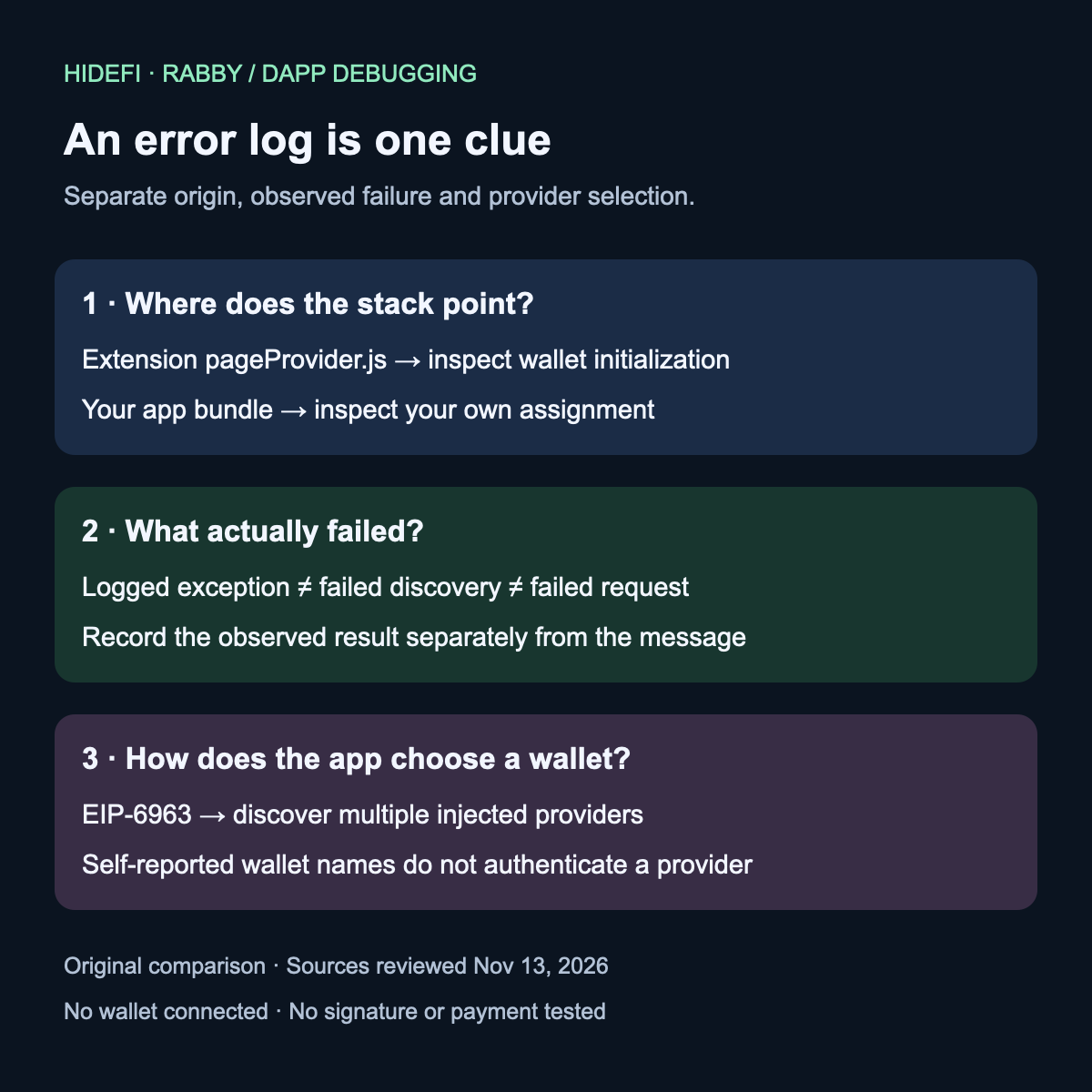
If the error’s stack points to Rabby’s injected pageProvider.js, start with provider initialization, rather than assuming your dapp or a transaction failed. The message means code tried to assign a property that exposes a getter without a setter. Its presence alone does not identify which wallet owns the provider or establish a failed payment.
A developer’s Rabby issue #3523 describes this exact monitoring problem: intermittent Cannot set property ethereum of #<Window> which has only a getter reports from the extension script, without a reproducible case. The useful clue was the script origin in the stack, rather than the exception wording by itself.
Separate the script origin from your app’s result
Keep the nonsecret message, script origin, browser and installed extension version together. A stack pointing into the extension is a different finding from an assignment in your own application bundle. MDN’s explanation confirms the JavaScript meaning; it does not diagnose a wallet balance or a network transaction.
Then check whether your app actually failed to discover the selected provider, or whether only an error log appeared. These observations need separate treatment. If the visible symptom is simply that a connection prompt never opens with several extensions installed, compare the separate wallet-extension connection checks. That guide is about the connection symptom, not proof that MetaMask caused this Rabby report.
What the current Rabby source establishes
Rabby linked the report to pull request #3525, merged March 6, 2026. It changed the page-provider dependency from 0.4.10 to 0.4.11. HideFi checked the v0.94.15 package manifest, which still pins 0.4.11, and reviewed that published package’s initialization source.
In its non-Opera initialization path, Rabby inspects the property descriptor before defining the provider. Assignment fallbacks are inside catchable paths, and caught errors are still sent to console.error. A logged exception can therefore remain visible even when that assignment is handled. This is source review, not a reproduction of the reporter’s browser or a guarantee that every provider request succeeds.
Avoid repairing the shared global by force
For a dapp’s provider-selection design, EIP-6963 addresses collisions around window.ethereum through provider announcement and request events. It lets applications discover multiple injected providers instead of assuming one shared global identifies the user’s choice. Wallet metadata is self-reported, so a familiar name or reverse-domain label is not authentication.
The useful outcome is a narrower report: an extension-origin initialization exception, a bug in your own assignment, or a separate provider-request failure. Do not hide all wallet errors or overwrite another provider merely to clear the log. No wallet connection, signature, payment or user monitoring data was used for this review.
Official sources
Product interfaces and recovery policies can change. Confirm the current steps before acting.