Need test HYPE for HyperEVM gas? Separate it from mock USDC, verify chain ID 998, and compare the faucet provider’s own eligibility rules.
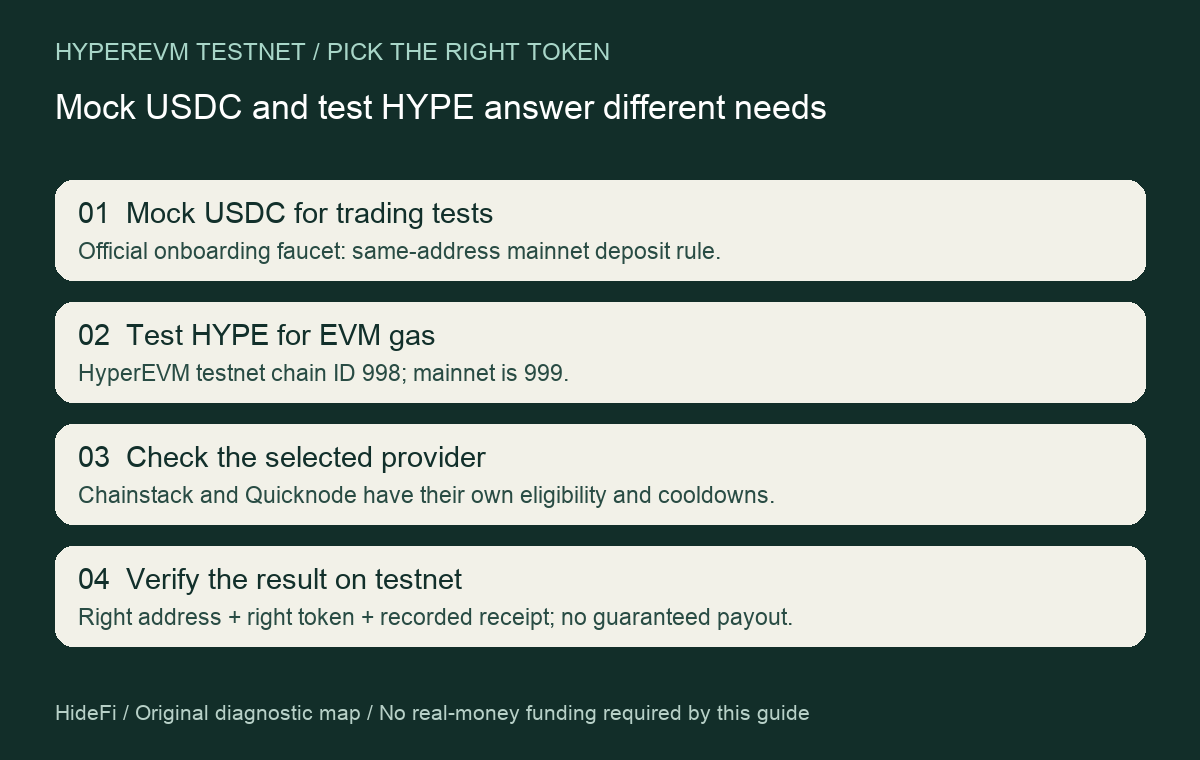
HyperEVM testnet transactions use test HYPE for gas; the Hyperliquid trading faucet’s mock USDC is a different token. If you searched for a “Hyperliquid testnet faucet” and found the wrong asset, identify the network and token before troubleshooting eligibility.
This is an illustrative mix-up, not a tested payout: a developer has mock USDC for trading tests but still needs gas for an EVM transaction. More mock USDC does not answer that gas requirement. The official HyperEVM reference identifies HYPE as the native gas token and separates testnet chain ID 998 from mainnet 999.
Match the faucet to the token you need
Hyperliquid’s onboarding faucet page describes 1,000 mock USDC for testnet trading and requires an earlier mainnet deposit by the same address. Its email-login warning concerns different addresses on mainnet and testnet. For that exact eligibility problem, use the existing mock-USDC faucet address checks.
For test HYPE gas, the separate official HyperEVM tools directory lists Chainstack and Quicknode. A directory listing establishes the intended token and provider route, not a promise that a provider will accept your address or pay immediately. Test tokens are for testing, not a claim to mainnet funds.
Provider eligibility is a separate check
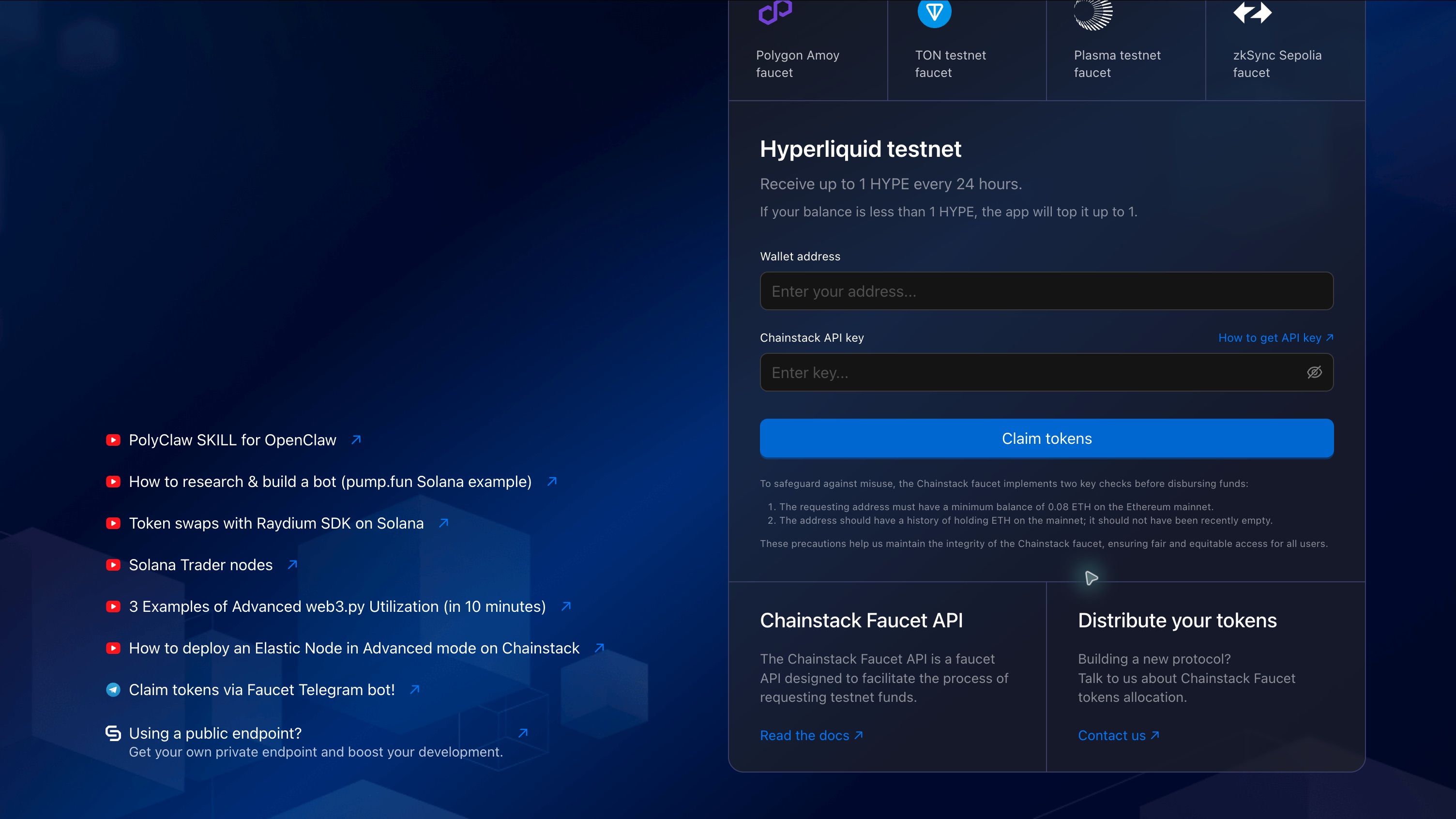
On November 12, the Chainstack faucet page shows an address field and an API-key field. It describes topping a balance below 1 HYPE up to 1, at most every 24 hours. The same page lists Ethereum-mainnet balance and history checks, including a 0.08 ETH minimum. That is the provider’s displayed condition, not Hyperliquid’s same-address deposit rule. Do not buy or transfer real assets just to satisfy a test-faucet tutorial.
The Quicknode FAQ describes a 12-hour cooldown per address and network, a small mainnet-balance check, and verification. It says the base amount appears after entering an address; do not infer that amount from another provider. Optional bonuses are not required. Its lack of a prior Hyperliquid-deposit requirement does not remove its other eligibility conditions.
What should you verify after a request?
Check that the selected destination is HyperEVM testnet, the expected token is HYPE, and any returned transaction or balance belongs to the intended public address on that network. A completed bot check alone is not a confirmed token receipt. If the provider rejects the request, record its exact nonsecret error and displayed eligibility or cooldown condition. A correct network and token do not establish the cause of every provider failure.
HideFi reviewed public documentation and the empty provider interface: no address, API key, wallet connection, verification challenge or claim was submitted. Do not send an API key or wallet secret to a troubleshooting chat. Current provider conditions can change, so recheck the provider page before using it.
Official sources
Product interfaces and recovery policies can change. Confirm the current steps before acting.